Morocco Field Day: Recap
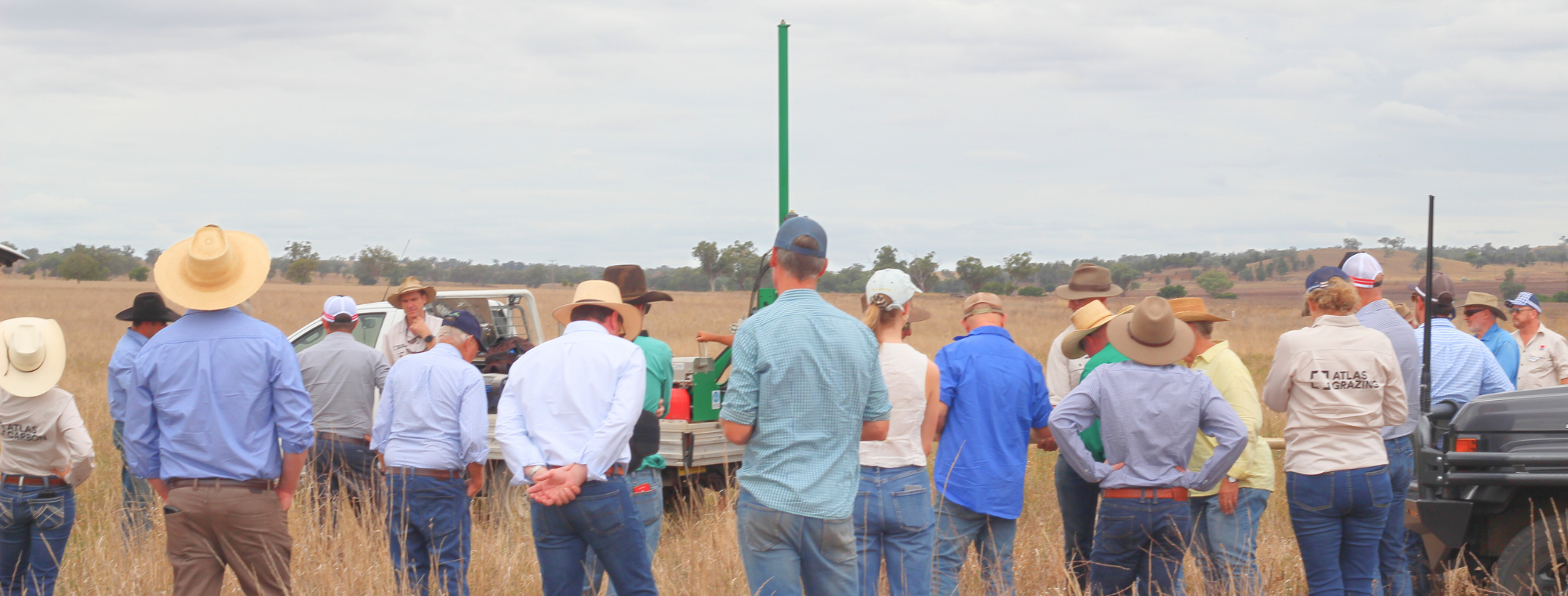


Productive Grazing Field Day at Morocco
On 3 March 2026, Atlas Carbon and Wilmot Cattle Company hosted a field day at Morocco, a 2,200 hectare beef cattle property near Gunnedah, NSW, managed by Brent Smyth.
The event brought together producers for a practical, grounded discussion on soil carbon, grazing management, and decision-making. Despite a warm forecast, conditions were favourable, making for an ideal day in the paddock, supported by good coffee, and even better conversation.
The day was split into two parts, with a morning ‘classroom-style’ session at Kelvin Hall, followed by lunch and then a short drive to Morocco for an afternoon paddock walk.
The objectives of the field day were
- To have honest, objective conversations
- To learn from each other
- To explore the relationship between rainfall, grazing, soil health, carbon, and productivity
- To support confident, informed decision-making
This field day was supported by the NSW Government’s HIP Program, in partnership with Atlas Ag and Wilmot Cattle Company. The program aims to reduce emissions and promote sustainable land management practices in agriculture, contributing to the state’s net-zero targets.
Morning Session: Setting the Foundation
The day began at Kelvin Hall, where Atlas Carbon’s Col Feilen unpacked the ACCU scheme and soil carbon projects, cutting through what can be a complex and confusing topic.

His key messages were:
- Soil carbon projects are, first and foremost, grazing projects
- They should be treated as another enterprise within the business
- Not all land is suited to a viable soil carbon project
- Robust due diligence is essential before getting started

Bart Davidson then built on this foundation by walking through Morocco’s history, drawing on more than a decade of data and experience working alongside Wilmot Cattle Company.
One concept that resonated strongly was the idea of “grass as a bank”. In this analogy, rainfall acts as deposits, grazing as withdrawals, and recovery as compounding interest, resulting in productivity and carbon outcomes.
This led into a deeper discussion on graze shape and how different grazing approaches influence plant recovery. When stock are left at low density for extended periods, plants are repeatedly grazed before they have time to recover. This creates a slow drain on the system, where pasture never fully rebuilds. As stock density increases and grazing duration shortens, recovery improves. The most effective systems push this further, using high stock density for short periods, followed by adequate rest. This allows plants to recover fully, promotes more even grazing, supports pasture diversity and improves nutrient distribution

Underlying all of this is plant physiology. After a graze event, plants prioritise leaf regrowth in order to restore photosynthesis. Only once energy reserves are rebuilt can they begin investing in root development.
When recovery is consistently achieved, root systems become deeper and more robust. This has flow-on benefits for drought resilience, nutrient access, soil structure and the stabilisation of carbon deeper in the soil profile.
The takeaway: grazing management is a primary driver of both productivity and soil carbon outcomes.
The session finished with a look at pasture yield data from the paddocks we would later visit. It provided a clear example of how Morocco has gradually increased stocking rates over time, supported by improvements in pasture productivity.
Afternoon Session: Walking the Paddocks
After lunch, the group headed five minutes down the road to Morocco to see these principles in practice.
We began with a soil core demonstration, offering a visual snapshot of root depth and soil structure that brought to life the concepts we’d discussed earlier in the day

Atlas Carbon’s Rafe Ritchie shared an analogy that captured the idea of plant recovery in a relatable way:
”Think of it like a car battery. If you’re constantly draining it with little things, like leaving the lights on, it slowly runs flat. But that same battery is built to deliver a big burst of energy when you start the car. It actually handles that better than being constantly chipped away at.
Pastures are pretty similar. If animals are always nibbling away in a set-stocked environment, the plants never really get a chance to recover; they just get run down over time. But if you come in hard with a high-density graze for a short period, you take a big bite all at once, then give the plants proper time to bounce back before the next hit.”
.jpg)
Brent Smyth then talked through the management of the paddock we were standing in. Since November, this part of the property has been running a consistent rotational grazing system with cow-calf pairs. Stock are moved through cells every few days, resulting in a full grazing cycle of around 45 days.
A recent change has been the application of gypsum at a rate of one tonne per hectare, aimed at addressing soil imbalances and improving soil condition. Following this, cattle completed another rotation, although Brent noted that the country still appears to be recovering and may require additional rest before reaching its potential.
He described the paddock as once being “high and rank”, with grazing pressure helping to open it up over time. Aside from the gypsum application, the approach has been intentionally low intervention, relying primarily on animal pressure to drive change.
Data-Driven Decisions on the Ground
The final discussion focused on how data can be used to support more confident grazing decisions, led by Bart Davidson and Debbie Hattie.

Debbie talked us through stock days per hectare (SDH) — a practical metric for understanding feed supply and planning grazing.
At its core, SDH answers the question “How much feed do I have, and how long will it last?”
A stock day represents the daily feed requirement of one livestock unit (LSU), where:
- 1 LSU = a 400 kg steer at maintenance
- 1 stock day = 1 LSU fed for 1 day
When expressed as stock days per hectare, the question becomes: “How many days of feed does this hectare provide for one LSU?”
In the paddock at Morocco, the group estimated that one LSU would require roughly a 10 × 10 metre area (100 m²) to meet its daily intake under those conditions.
Given that:
- 1 hectare = 10,000 m²
- 10,000 ÷ 100 = ~100 stock days per hectare
This can be interpreted in several equivalent ways:
- 1 hectare could feed 1 animal for 100 days
- Or 100 animals for 1 day
- Or 50 animals for 2 days
The total feed resource remains the same; it’s simply expressed differently depending on how it’s used.
The paddock we stood in was 20ha, so in theory, you could graze 2000 LSU in the area for one day.
Don’t forget to consider how much residual you want left post-graze!
The goal is to develop the ability to assess feed availability quickly and reasonably accurately, directly in the paddock.
For example, you might estimate:
- Pre-graze: ~100 SDH
- Post-graze: ~50 SDH
You can then compare these estimates with data from Atlas Grazing to validate and refine your judgement.
The key isn’t perfect accuracy, but continuous improvement.
Each grazing event becomes a feedback loop:
- Estimate how many SDH were utilised
- Compare your estimate with recorded data
- Adjust your mental model accordingly
Over time, this process sharpens your observational skills and builds confidence in day-to-day decisions.
As Bart emphasised:
“No one starts out accurate, but everyone can improve. The more you estimate and calibrate against real data, the better your eye becomes.”

Wrap Up
The Morocco field day reinforced a clear message: soil carbon outcomes are a by-product of good grazing management.

By focusing on recovery, observation and measurement, producers can improve productivity, build resilience and create the conditions for increasing soil carbon. Just as importantly, the day highlighted the value of open and practical conversations, grounded in real experience and supported by data.
Thank you to everyone who joined us on the day. We hope you gained some valuable insights.
Our next HIP field day will be held on the 22nd of April at Deepwater Station, NSW. Learn More
.png)
.png)
.png)


