Deepwater Station Field Day
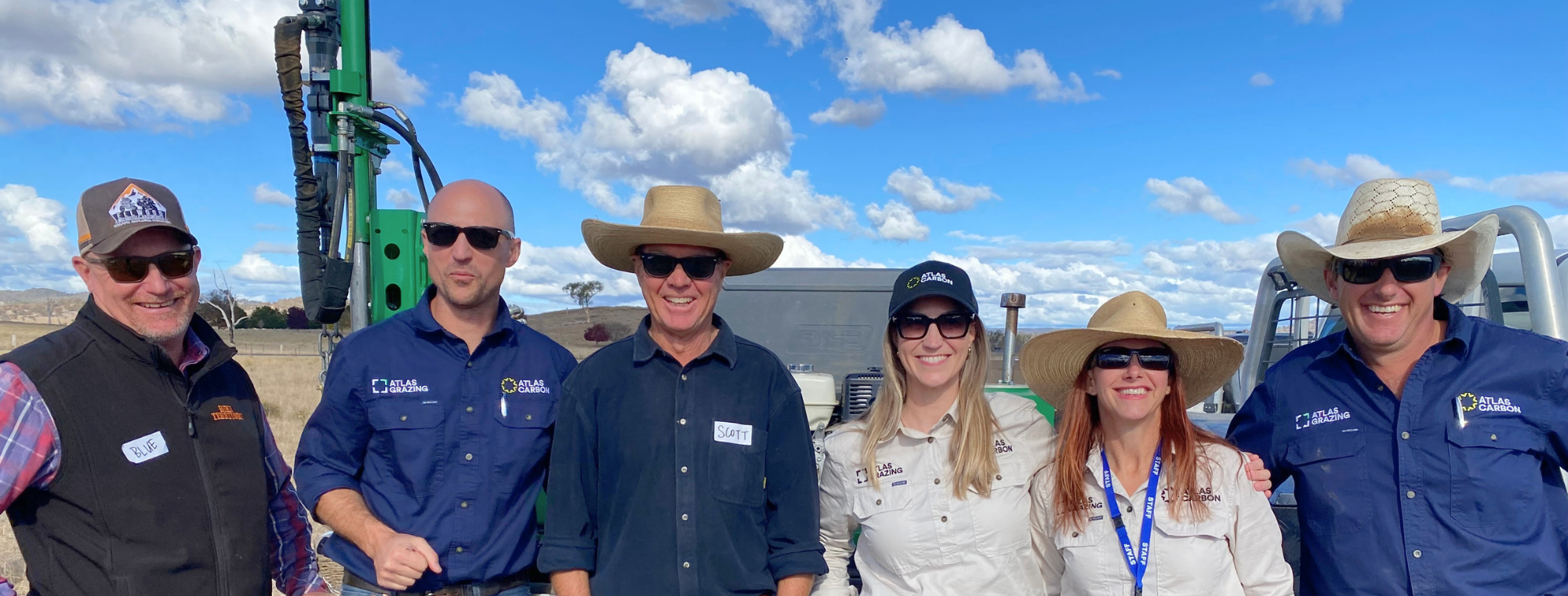


Productive Grazing Field Day at Deepwater Station
On Wednesday, 22nd April 2026, Atlas Carbon and Atlas Grazing hosted a field day at Deepwater Station, a 1,625 hectare merino and beef cattle property on the Northern Tablelands near Deepwater, NSW, managed by Scott Macansh and his family.
Scott Macansh’s management is the latest chapter in a 150-year family story on Deepwater Station. It is, in every sense, a working property, and one that has been moving deliberately towards a lower-input, more pasture-focused system for some time.
You can learn more about Deepwater Station, its rich history and farm-visit opportunities here.
It was pleasing to see a strong turnout to the field day of 28 people, which is much appreciated considering the trying conditions being faced by a large number of farms in New South Wales currently. We had a great mix of producers, and even a handful of industry representatives, with some attendees travelling over 3hrs to make it to the field day. Thank you!
The morning kicked off at the Deepwater School of Arts Hall, before a convoy out to Deepwater Station for the afternoon paddock walk. The day wrapped up with refreshments and informal chats with attendees who chose to stick around, which was the majority!
This field day was supported by the NSW Government's High Impact Partnership (HIP) Program, in partnership with Atlas Carbon and Wilmot Cattle Company. The program aims to reduce emissions and promote more resilient land management practices in agriculture, contributing to the state's net-zero targets.
Dry times
It would have been easy to schedule this field day for a season when the landscape was looking its best, when a lick of rain turns everything green and it all looks effortless. But it's just as important, if not more, to be running these on-farm conversations when we're in dry times, keeping things real.
Like a lot of NSW currently, conditions at Deepwater are dry, and have been for some time. It was impressive to see how much groundcover was still present across the property, a direct reflection of Scott's management. The country that's been cared for, soils considered and pastures nurtured well before drought set in, will be rain-ready when the season turns.

Morning Classroom Session
After some fantastic coffee and scones, the day officially opened with Atlas Ag's Victoria Lawrance walking through the Australian Carbon Credit Unit (ACCU) scheme, and what a soil carbon project actually involves. It's a topic that attracts a lot of noise, and Victoria’s honest approach cut through it well. Her core messages were the same ones that underpin everything Atlas Carbon does:
- A soil carbon project is, first and foremost, a grazing project
- Not every property with soil has a viable carbon project. Viability needs to be established through robust due diligence
- The project should be treated as another enterprise within the business, with all the rigour that implies

As Atlas Ag’s Col Feilen put to the room: "We're at a fortunate stage where farmers are being rewarded for things above food, fibre and genetics."
Scott introduced the Deepwater Station story, and the group was treated to a series of property maps showing the development of water and wire across the station over the years. The property initially ran around 34 paddocks averaging approximately 45 hectares each, with stock set-stocked across most of them. Animals were eating everywhere at once, and paddock recovery time was close to zero.
Scott began his paddock subdivision by selecting a flat open area with good water, and good country, close to infrastructure. He turned two paddocks into eight, consolidating two mobs into one. Stock grazed in this area for the same time as previously, but paddock recovery time went from almost zero, to 87.5% of the time.
Today, every major paddock at Deepwater has been split up, with water infrastructure at the heart of every decision. The goal is to maximise every hectare of the block, and Scott can, and is, planning to take the paddock splitting further. As he put it himself, the improvement gets addictive.

Across the day, the discussion was always grounded in production.
We talked through how grazing intensity and recovery interact over time. When animals graze at low density for extended periods, plants get repeatedly bitten before they have a chance to rebuild. Energy reserves run down, root development suffers, and the system slowly moves backwards. Shift to shorter, more intensive grazes with proper recovery in between, and the picture changes. Plants rebuild. Roots push deeper. Ground cover lifts. Soil structure improves.
We also covered the relationship between drought resilience and how a property has been managed going into dry conditions. A system built on genuine recovery (perennial grasses with deep roots, adequate groundcover, well-functioning soils) handles moisture stress differently from a system that's been running on empty. It goes into dry holding something in reserve. When rain comes, it responds faster.
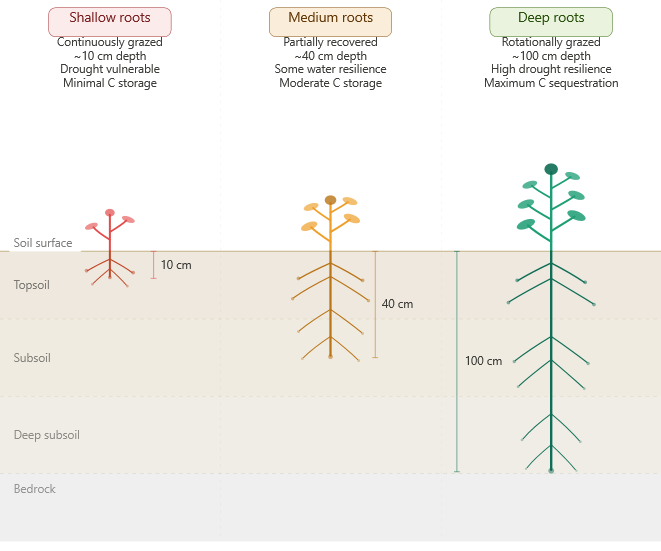
We were fortunate to have some great literature on hand at the Deepwater Field day from the team at SoilCQuest, a not-for-profit research institute. It was great to see attendees taking advantage of their free educational pamphlet on Soil Carbon.
Afternoon Paddock Walk
TThe afternoon paddock walk drew together everything discussed in the morning.
Demonstrating the process of soil core sampling, Rafe fired up the rig and took one soil core in the paddock at Deepwater Station, down to 140 centimetres. And when he pulled it from the ground and laid it out for the group, it was inspiring to see living perennial grass roots running the full depth of the sample. One hundred and forty centimetres of root system, in the middle of a drought. It’s a real testament to Scott’s years of considered management, and one of the reasons this country is able to hold its ground cover when much of the surrounding landscape isn’t.
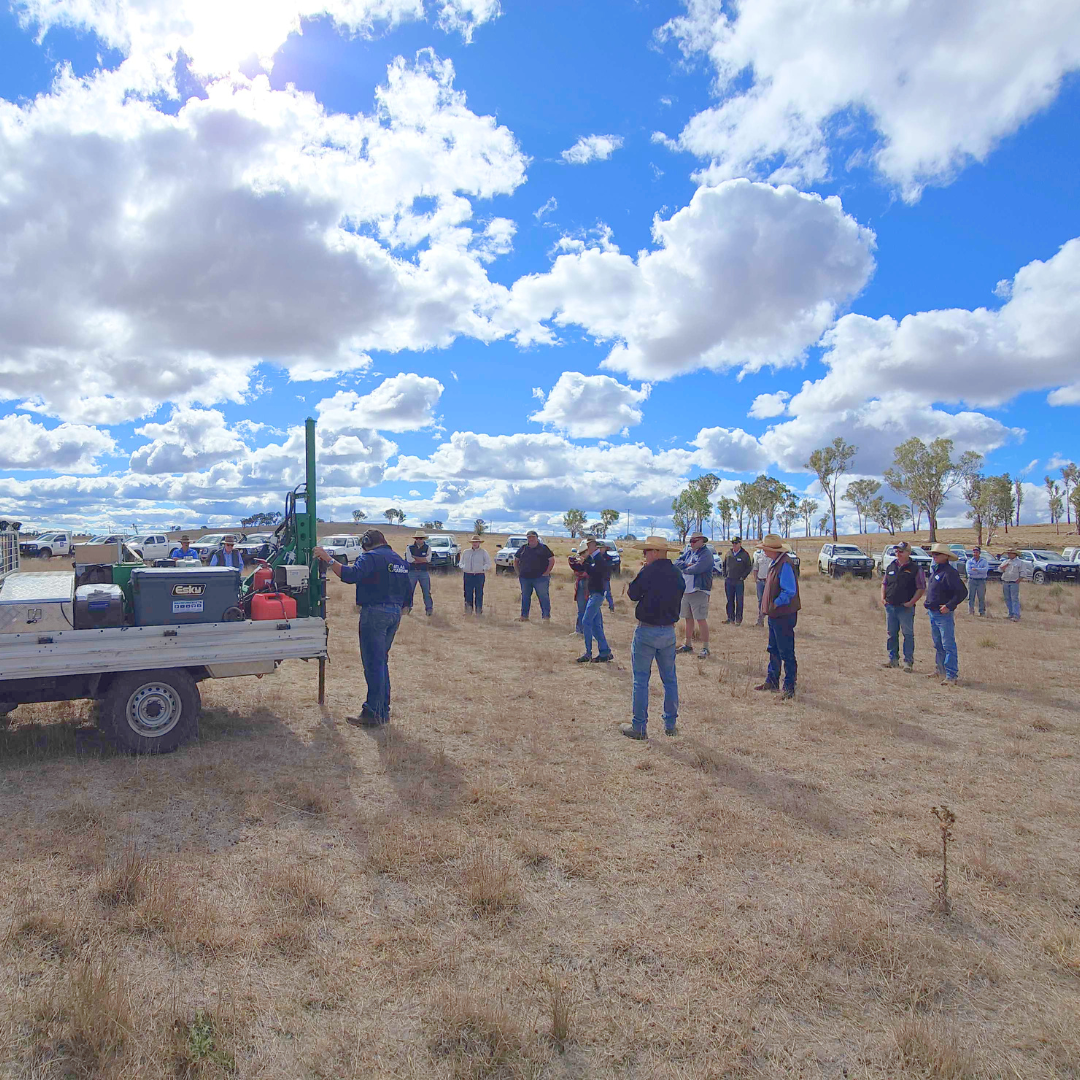
The coring demonstration also sparked a rich thread of questions from the group around soil carbon measurement, project eligibility, and how credits flow to farmers over time. Several current Atlas Carbon project holders were in the conversation, which added valuable insight about what a project actually looks like when you’re living it day-to-day.
In the paddock, Scott fielded a number of questions from attendees about his management.
Questions covered how the mobbing-up of livestock affected animal production, and Scott spoke frankly about finding the balance. He started with Holistic Management and was, by his own admission, "very zealous" before backing off as he found it was hard on the animals. What followed was a more measured approach, managing recovery without overstressing the herd. He's learnt to read both the animals and the pastures.
On the topic of fertiliser inputs, Scott was equally honest. He had stepped away from phosphorus applications for a period, hoping the soil biology would do the work. He found the pastures still needed something to kickstart them, and he's returned to targeted applications.
The conversation also touched on compost tea and other holistic inputs Scott had explored. He found that feeding the biology at scale wasn't sustainable, and shifted focus to contours as a more practical option for influencing water movement and soil health across the property.

A Podcast in the Paddock
On the sidelines of the field day, Victoria found a moment to record a new episode of the Stockyard Sessions podcast with Jake Smith from BJS farming. Make sure you’ve joined our mailing list, and follow us on socials so you don’t miss its release!
Reflections
The Deepwater Station field day reinforced that it's in those moments when the landscape is under pressure and the decisions are harder, that the principles of good grazing management are truly put to the test. What we saw at Deepwater Station was a testament to approaching your grazing management with soil health in mind.
Thank you to Scott Macansh for opening Deepwater Station and for the generosity with which you shared your experience and land.
Thank you also to everyone who attended, especially those that travelled considerable distances to be there. We hope you found value in the day.
SAVE THE DATE: our next free on-farm field day, will be held near Coonamble NSW, on Wednesday 27th May. Details will be shared via email and social channels shortly.
Read ‘The Land’ article about the Deepwater Field Day: ‘Looking beyond drought with grazing management to build resilience’.
Read the recaps from our past field days
.png)
.png)

.png)


