Field Day at 'Grovedale'
.png)


Soil Carbon Field Day at 'Grovedale', Trunkey Creek, NSW
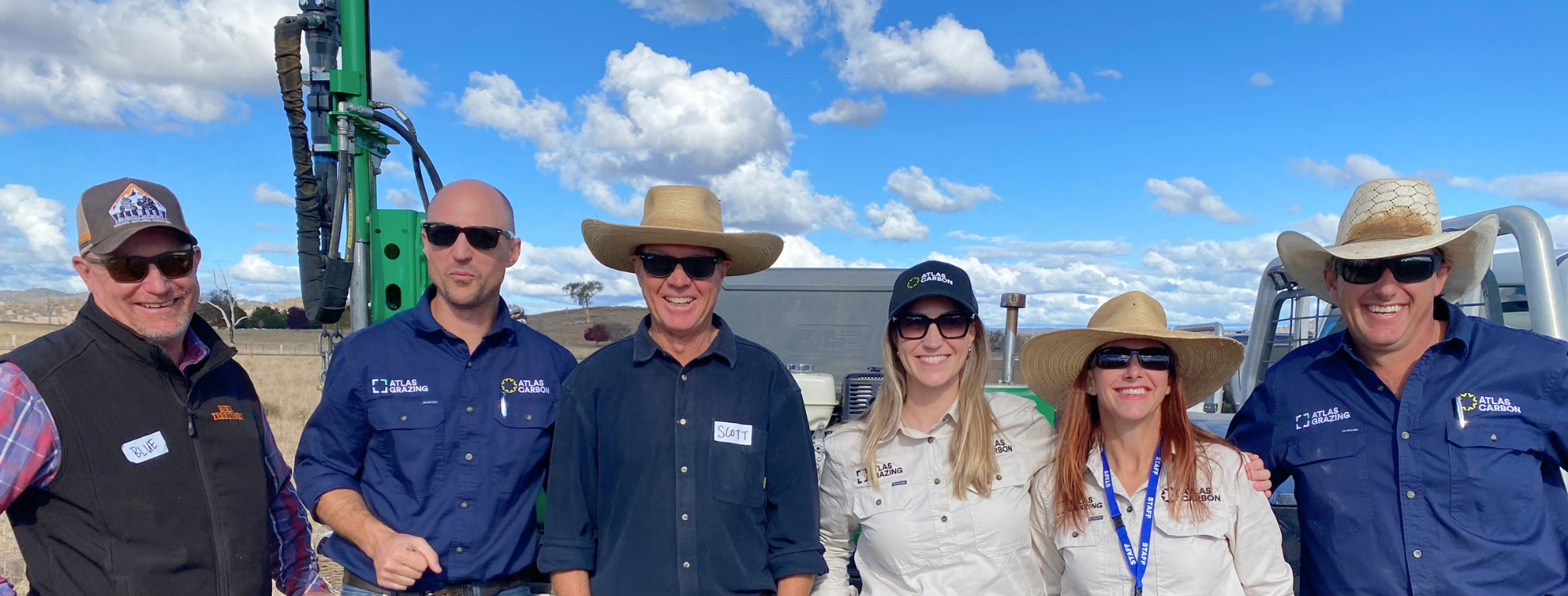
Meet the Hosts: Scott and Karen Brown
Scott and his wife Karen are the fourth generation on 'Grovedale'. Not afraid to challenge tradition, Scott has a history of adapting his business, adjusting from a breeding herd to trade cattle, while the self-replacing Merino enterprise has evolved with a focus on improving reproductive performance. He’s currently running over 4,000 head, including Merino sheep and Angus heifers, on 772ha.
Scott is currently running a soil carbon project on his property in partnership with Atlas Carbon. He sees the project's forecasted income as "an extra wool clip every four years," providing an off-farm income stream without leaving the property.
Event Recap: Grovedale Field Day
On the 28th of October 2025, on a bitterly cold Trunkey Creek morning, we joined fourth-generation grazier Scott Brown at his 772-hectare property Grovedale, along with a cohort of producers, consultants, and industry professionals. Huddled around a well-received coffee cart, conversations warmed up even if the weather didn’t, setting the scene for our third official High Impact Partnership (HIP) Soil Carbon Field Day in New South Wales.
From the outset, the group was eager to dive into Scott’s management journey and explore how his grazing practices are evolving alongside his approach to carbon sequestration.
The field day at Grovedale was supported by the NSW Government’s HIP program with Atlas Carbon and Wilmot Cattle Company. This program aims to deliver emissions reduction and promote sustainable land management practices in agriculture to support NSW’s net-zero target.
Woolshed Chats
The day began in the woolshed, where Scott shared the history of Grovedale and the evolution of his management approach.
A standout theme was his adoption of the motto “more testing, less guessing”. Scott described the day he spent soil testing with the Atlas Carbon team - assessing the viability of a soil carbon project - as “one of the best days” he’s had on farm.
”The biggest change I think I’ve observed is in my mindset. I think of myself as a grass farmer”.
Atlas Carbon’s own Col and Bart then took the floor, focusing on the power of data-driven grazing decisions and the role of numbers in building resilience and lifting production.
.png)
Bart highlighted the gap between cropping and grazing when it comes to data literacy:
“Cropping has a language to talk about the numbers in their operation; grazing didn’t at all. We’re getting better, but it’s still not the standard thing”
They also discussed the importance of planning for plant recovery—allowing plants to restock their energy reserves between grazes by utilising high stocking density for short durations.
”If we put 1000 mouths on a pasture for a day, or 100 mouths for 10 days, we’re still talking about the same amount of grass harvested by the animals”
”Plants, just like us, can deal with stress. I can deal with stress every Monday and Tuesday. But if I do it every day of the week or month, I’m no good. Plants are the same. They need recovery.”
Paddock Walk
After lunch, we headed out to see Scott’s grazing system and soil carbon project in practice.
Across several paddocks, Scott explained how he scores each paddock out of 10 to help guide the timing of grazing. Underfoot in the second paddock was a beautiful representation of a phalaris-based diverse pasture, with a strong distribution of chicory and clover.

Scott reflected on past challenges:
“We’ve never had any luck with chicory before. It’s the first thing the sheep eat, so with set-stocking it never had time to recover; it just got slammed. Now look at it - it’s integrated beautifully”
A major component of the Browns’ carbon project has been a focus on water and wire, with significant subdivision to enable higher stocking density. With support from the NSW Government’s HIP program, the farm has gone from 24 paddocks to 78.
Throughout the walk, Scott frequently referred back to data recorded in MaiaGrazing - dry matter estimates, grazing durations, and recovery periods.
“This paddock was last grazed 14 days ago, so it has at least another 26 days before it sees stock again - probably longer. I’d expect it to at least double in feed between now and then”
The final paddock of the tour was the most striking. As Bart Davidson summarised in a recent webinar:
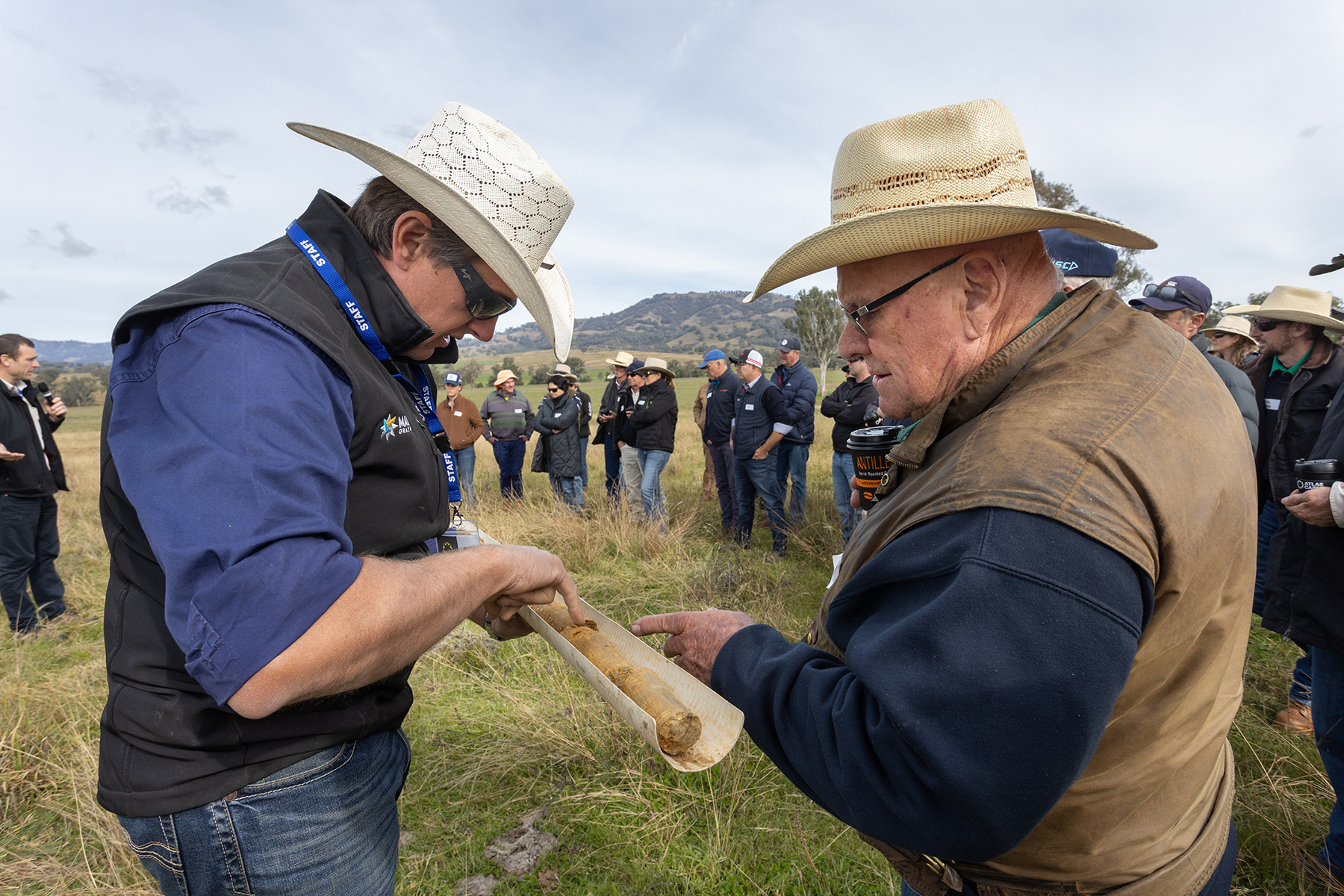
“One of the absolute highlights was pulling a 70cm soil core, randomly, on the top of a lighter hill and seeing roots punching 60-70cm into soil, that simply weren’t there 12 months ago. It was extraordinary.”
Historically, this paddock had been low-performing due to rocks making it difficult to work. A diverse pasture and rotational grazing have transformed it into a standout performer.
.png)
“Our measure of success is the grass, not just the animals we’re grazing on it.” - Scott
Reflections
The day wrapped up back at the woolshed for some refreshments and networking. A huge thank you must go to Scott for generously opening his property and sharing his soil carbon and grazing journey with the group. It was a fantastic day on-farm.
Grovedale is a reminder of what is made possible when you operate with intention, a willingness to try something new, a commitment to data, and trust in the process and the plan.
Bart captured the sentiment well:
“I think Scott is the embodiment of why we love doing this stuff. He's just an enthusiastic go-getter that will never say die, and he gets the job done.”
Want to hear more about Grovedale?
- Watch our recent webinar: 'Field Day Findings - Insights from Four Family Farms'
- Check out the field day article in 'The Land'
- Read the ‘Grovedale’ downloadable case study
.png)


.png)


